
ScamShield
An AI security analyst for normal people.
- Year
- 2026
- Status
- Live
- Category
- Security

01 / Overview
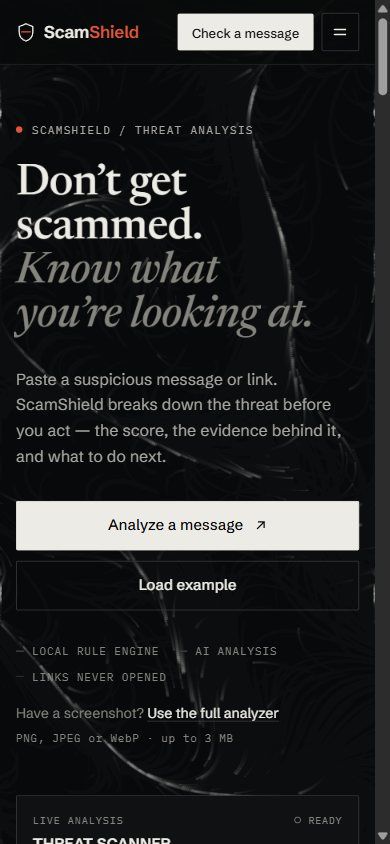
ScamShield analyses suspicious SMS, WhatsApp messages, emails, DMs and links. Most scam-detection tools answer the wrong question: they say "this is a scam" and stop. ScamShield explains why something looks risky, how the attack would work, and what to do next, so people recognise the next one without help.
It runs two independent analyses and shows its working. A deterministic rule engine and URL analyzer run first and always, producing a complete report on their own. Google Gemini adds the reading of intent that pattern matching cannot do. Pull the API key out and ScamShield still works; that is a deliberate, tested architectural property.
The full product is live: a landing page, an analyzer that takes text, links or a screenshot, shareable threat reports, an attack simulator that walks through how a scam unfolds, a dashboard of past analyses and a library of common scams.
02 / Problem
Verdict-only scam detectors help once and teach nothing. When they are wrong, the user has no way to tell.
The people most often targeted, such as parents, students and first-time earners, need to understand what they are looking at, not just be told yes or no.
03 / Solution
- 01A deterministic rule engine and URL structural analyzer produce named signals with quoted excerpts from the user's own message.
- 02Gemini runs as a semantic layer on top, returning a fixed JSON schema that is re-validated server-side with Zod.
- 03A documented fusion formula (rules 55%, AI 45%) produces a transparent score; when the AI layer is unavailable the rule score stands alone rather than being scaled down.
04 / Features
- 01Analyzer for text, links and screenshots, with a full threat report for each
- 02Shareable report pages, an attack simulator, a dashboard of past analyses and a scam library
- 03Deterministic message rule engine with weighted, de-duplicated signals
- 04URL structural analysis (IP hosts, punycode, shorteners, sensitive paths)
- 05Brand-impersonation heuristic
- 06Gemini semantic layer with structured output
- 07Model fallbacks, retries, request timeouts, rate limiting and input validation
- 08Works fully without an API key
05 / Architecture
- 01Input validation (Zod, server-side) → text and URL extraction
- 02Rule engine + URL analyzer run in parallel → security signals
- 03Gemini structured JSON → Zod validation and semantic repair
- 04Risk engine fuses both scores → threat report with severity bands
- 05Prompt-injection defences: structured output, per-request random delimiters, explicit system instructions, server-side re-validation
- 06GEMINI_API_KEY is read in a single server-only module and never exposed to the client
07 / Documented outcomes
- 01Measured scores from the deterministic test suite: banking phishing 66, fake internship 54, UPI PIN scam 55, ordinary message 0.
- 02Submitted messages are never written to application logs; nothing is persisted unless the user explicitly saves an analysis.